Comparison
img2gamecube vs img2threejs: picture to Three.js code, or picture to a playable 3D game
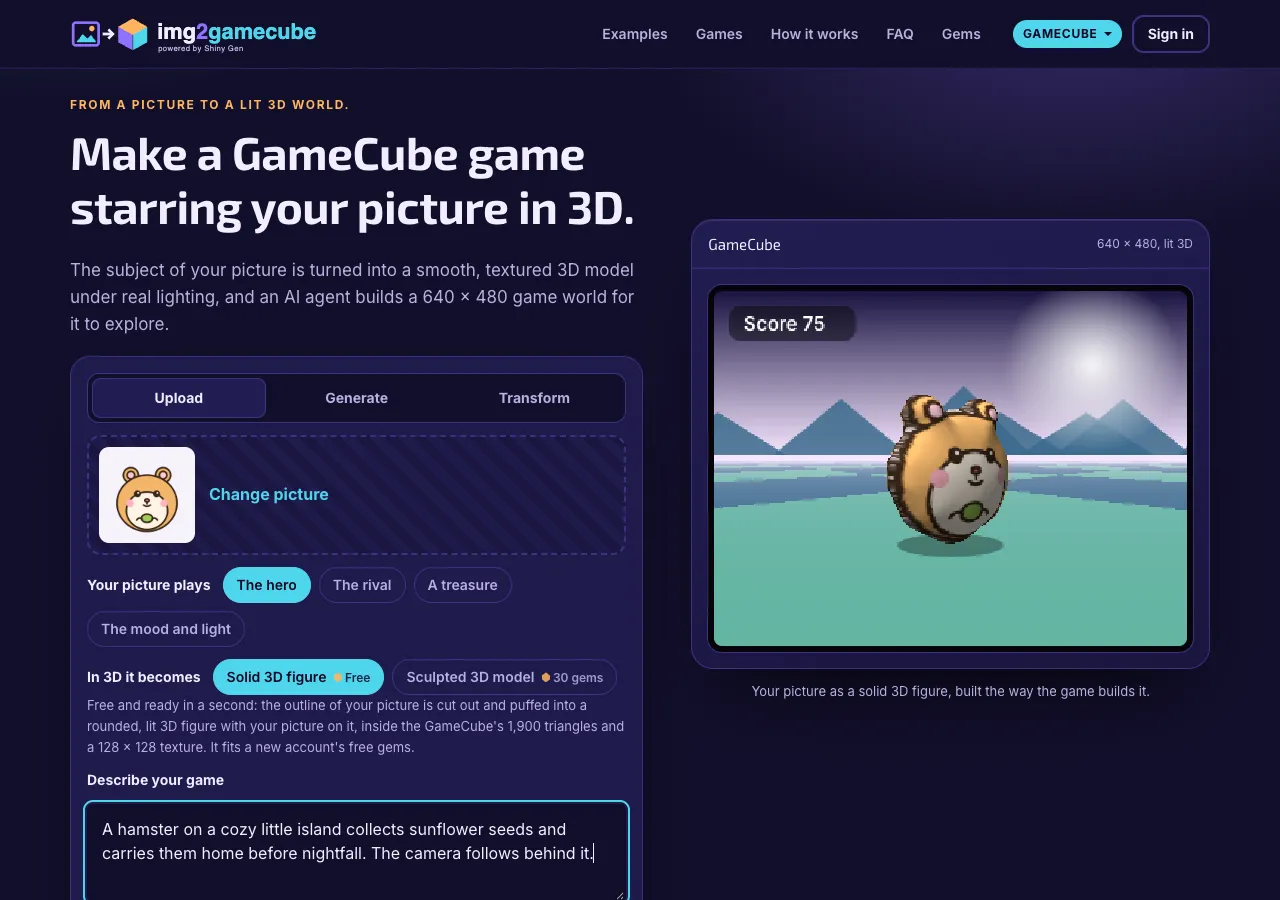
img2threejs and img2gamecube both start from one picture and end in 3D, but they are built for different people. img2threejs is an open-source skill (Apache-2.0) for coding agents such as Claude Code, Codex, OpenCode and Hermes: it rebuilds the object in your picture as a procedural Three.js model, written as TypeScript code, and checks each pass against the picture. img2gamecube is a website: you drop a picture, it becomes a free, lit 3D figure in about a second, and an AI agent builds a playable 3D game for our GameCube engine around it, in the browser, with nothing to install.
Also in: Español · Deutsch · Français · Português · Italiano · Nederlands · Svenska · Norsk · Bahasa Indonesia · Türkçe · Polski · Tiếng Việt · Русский · 日本語 · 한국어 · 繁體中文
On this page
If you are a developer who wants a faithful, animation-ready model as code in your own Three.js project, img2threejs is the one. If you want your drawing, pet or toy walking around a lit 3D world you can play and share in a few minutes, that is what img2gamecube is for. Everything below about img2threejs comes from its own README and docs.
At a glance
| img2threejs | img2gamecube | |
|---|---|---|
| What it is | An agent skill, Apache-2.0 | A website powered by Shiny Gen |
| Where it runs | In your coding agent: Claude Code, Codex, OpenCode or Hermes | In the browser and the Shiny Gen apps |
| What you install | Node.js 18+, Git, Python 3.10+, then the skill | Nothing |
| What it makes | A THREE.Group factory in TypeScript, plus a JSON spec | A playable 3D GameCube game with your picture as a 3D figure |
| How the 3D is made | Rebuilt from primitives, procedural shaders and generated geometry, one reviewed pass at a time | Free: the subject's outline inflated into a rounded, textured body in about a second. Paid: a sculpted image-to-3D model |
| Detail | As far as its quality gates push it | Up to about 1,900 triangles and a 128 x 128 texture, made for the console |
| Who builds the game | You | An AI agent, which also playtests it |
| Cost | Free software; you pay for your agent's tokens (the docs estimate about 80k to 180k per object, 150k to 350k for a character) | The figure is free; new accounts get 30 free gems; a first game took about 10 gems in our runs |
What img2threejs does well
img2threejs describes its job as "Rebuild the object in a reference image as a code-only, procedural Three.js model." It does not extract a mesh or download art: it writes code that builds the object. A few things stand out:
- A careful, gated pipeline. It writes a spec of the object first, then generates the model in passes: blockout, structural, form, material, surface, lighting, interaction, optimization. After each pass it renders the model, puts it beside the reference on one comparison sheet, and has the agent judge it. A strict-quality gate blocks code generation until the spec and a detail inventory (bevels, screws, painted lines, wear) are complete.
- Ready to animate. The output has a runtime hierarchy of pivots, sockets and colliders, "so the result is ready to animate, not an inert lump". A character plugin adds rigging and animation.
- Text, not binaries. The result is diffable TypeScript and a JSON spec, small enough to review and keep in version control.
- Built to save tokens. Validation, gating and bookkeeping run in plain Python scripts, so the model's tokens go to visual judgment and code.
- Honest about likeness. For a specific person or character it has a projection-first path, and it says plainly that "a single image cannot guarantee 100 percent likeness", reporting per-region confidence instead.
Its live demo gallery shows what that produces: a guitar, a starship, characters and a small snowy village game, every one of them code running in the browser.
What img2gamecube does instead
img2gamecube is not a model tool. The picture is the start of a game.
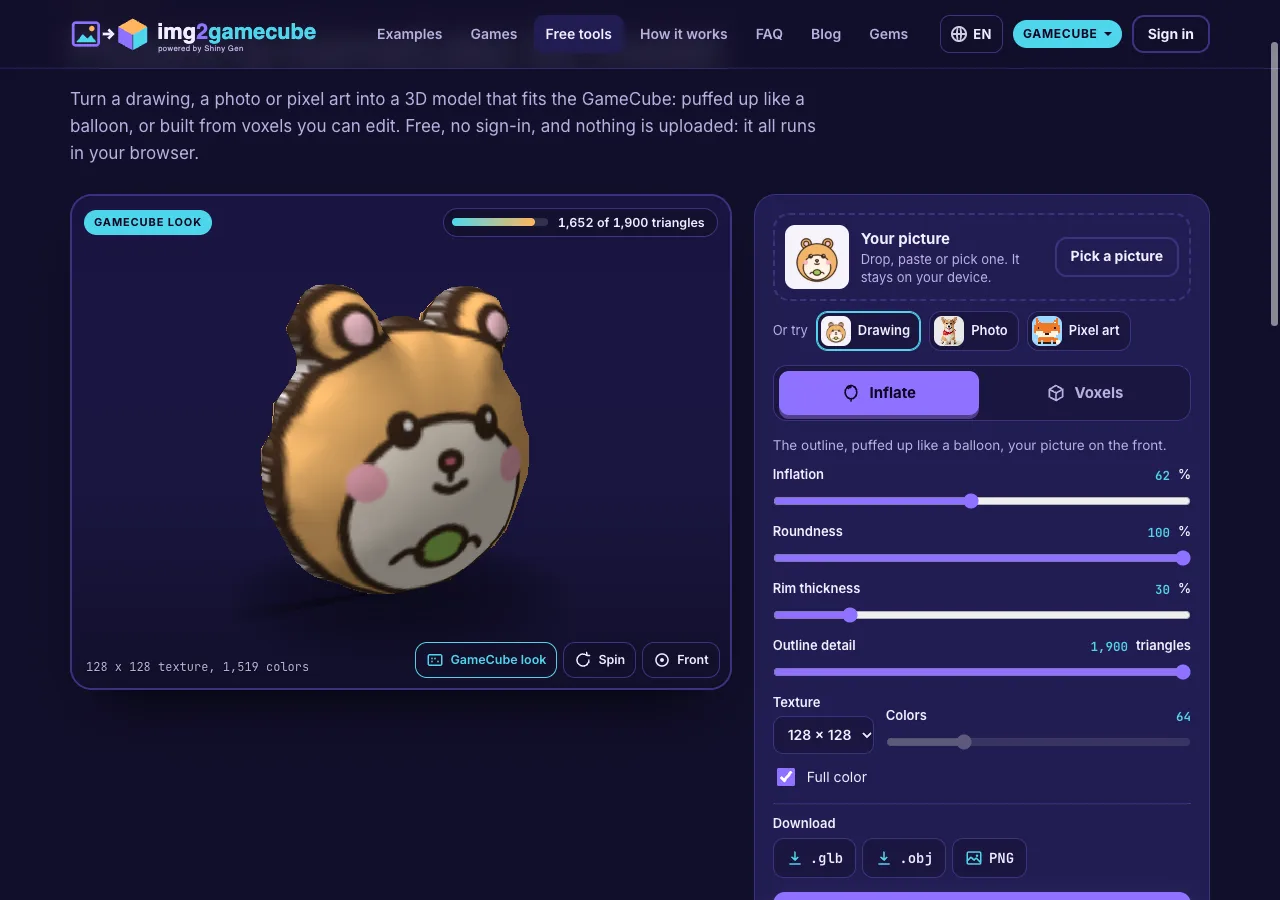
- The picture becomes a figure made for the console. The app finds the subject, traces its outline and inflates it into a closed, rounded body about as deep as a plush toy, then maps your picture onto it at 128 x 128. It is real geometry: the GameCube's lights shade it, it casts a shadow and it can turn in any direction. It takes about a second and costs no gems, and the start card shows it under GameCube-style light before you start.
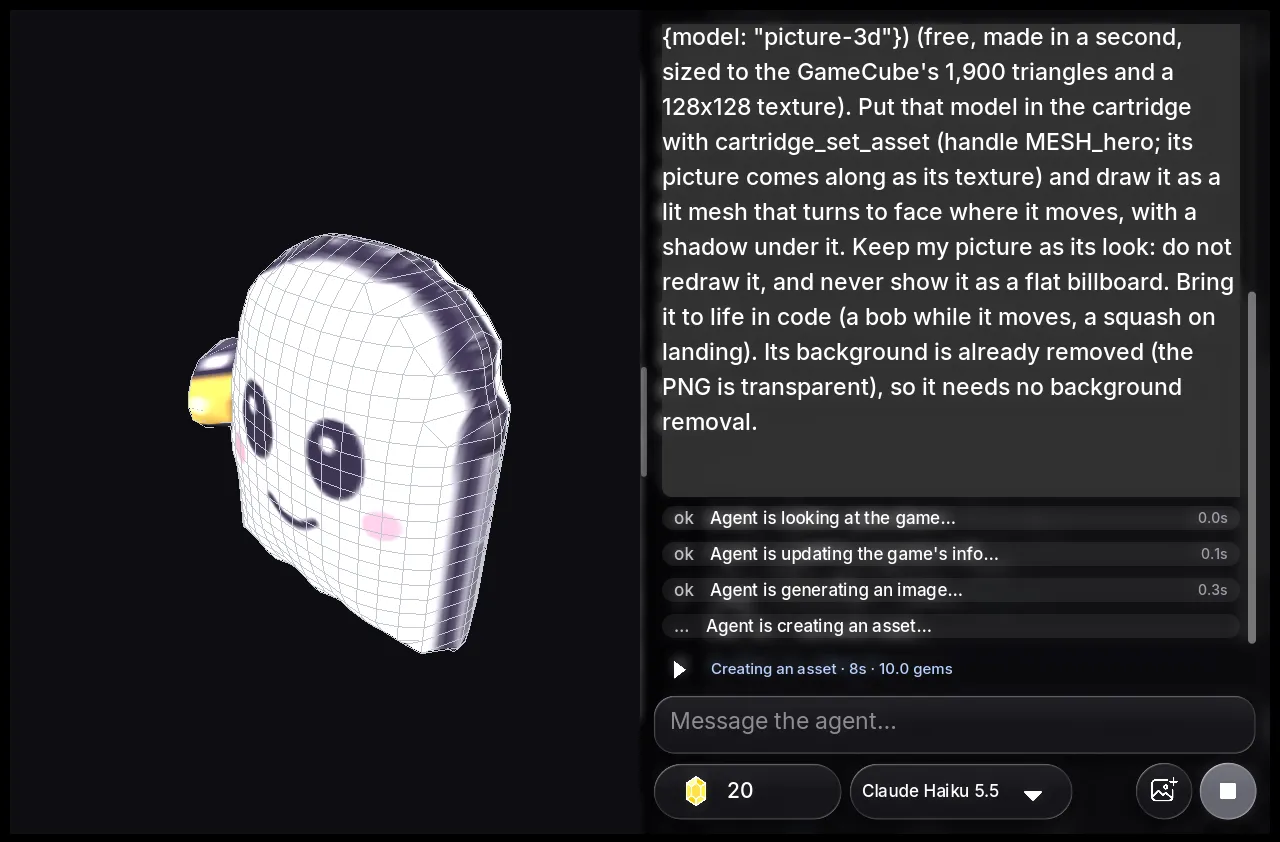
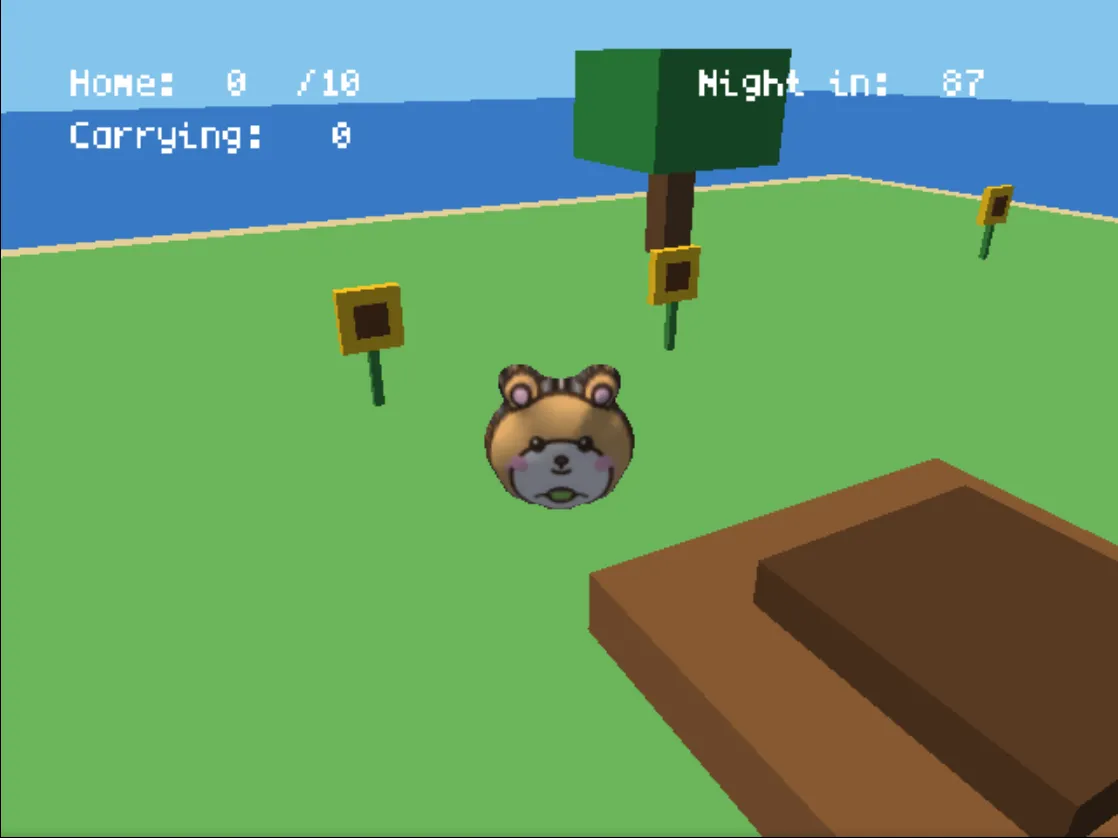
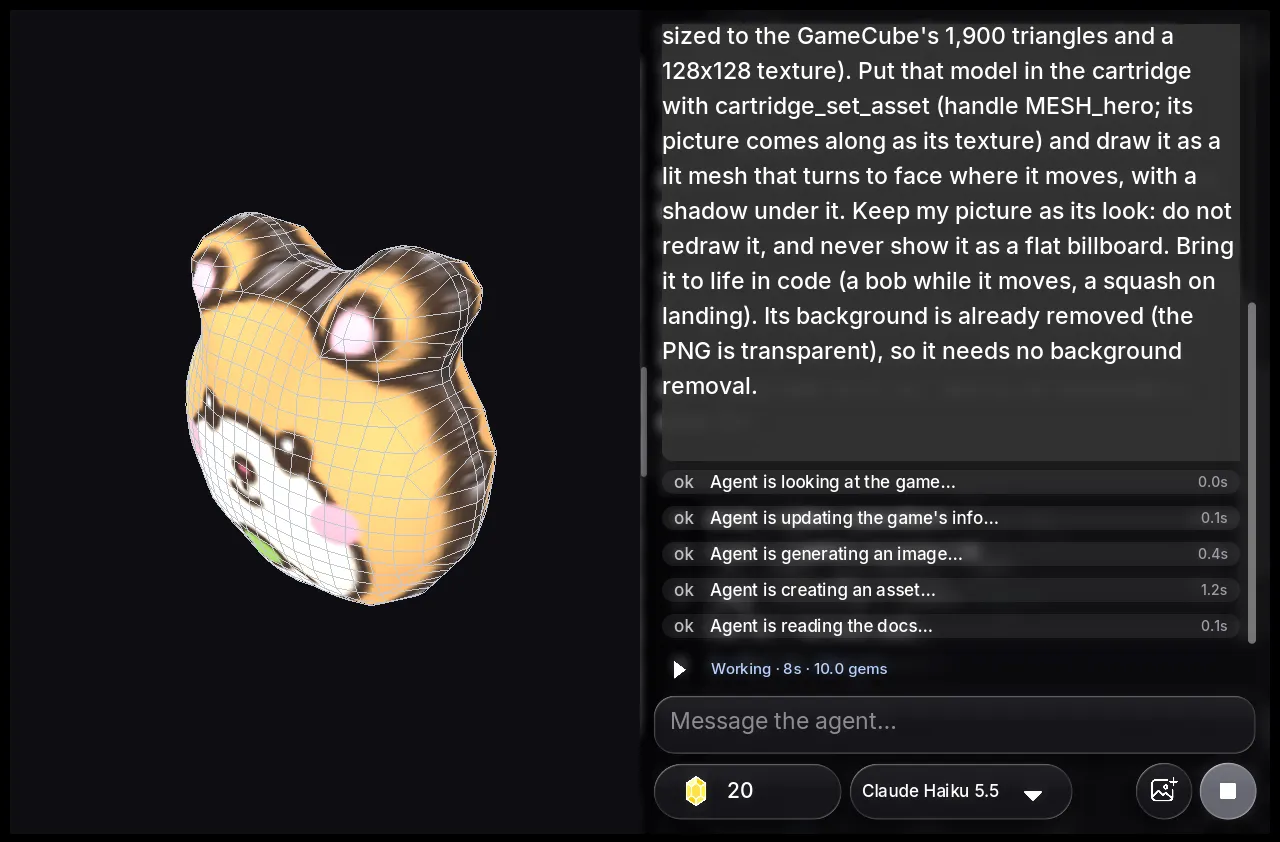
- An agent writes the game around it. Your words and the figure go to an AI agent that sets up a camera, lights and a level, writes the game in a small C-like language, compiles it to PowerPC machine code and links a
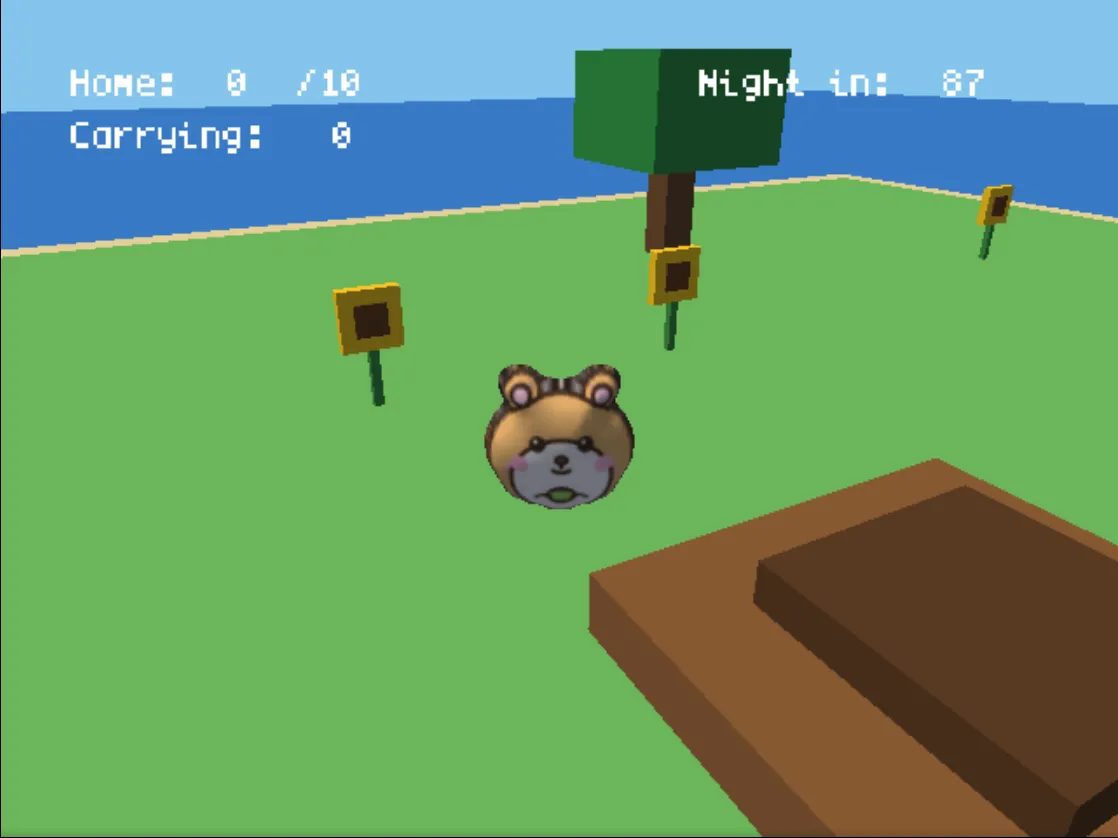
.dol, the format the console runs. Then it plays its own build, reads the screen and the frame cost, and fixes what it finds. - You play it. In the browser on a phone or a computer, in the Shiny Gen apps for iPhone, iPad and Android, or through a share link on img2gamecube.com. Then you keep changing it by chat.
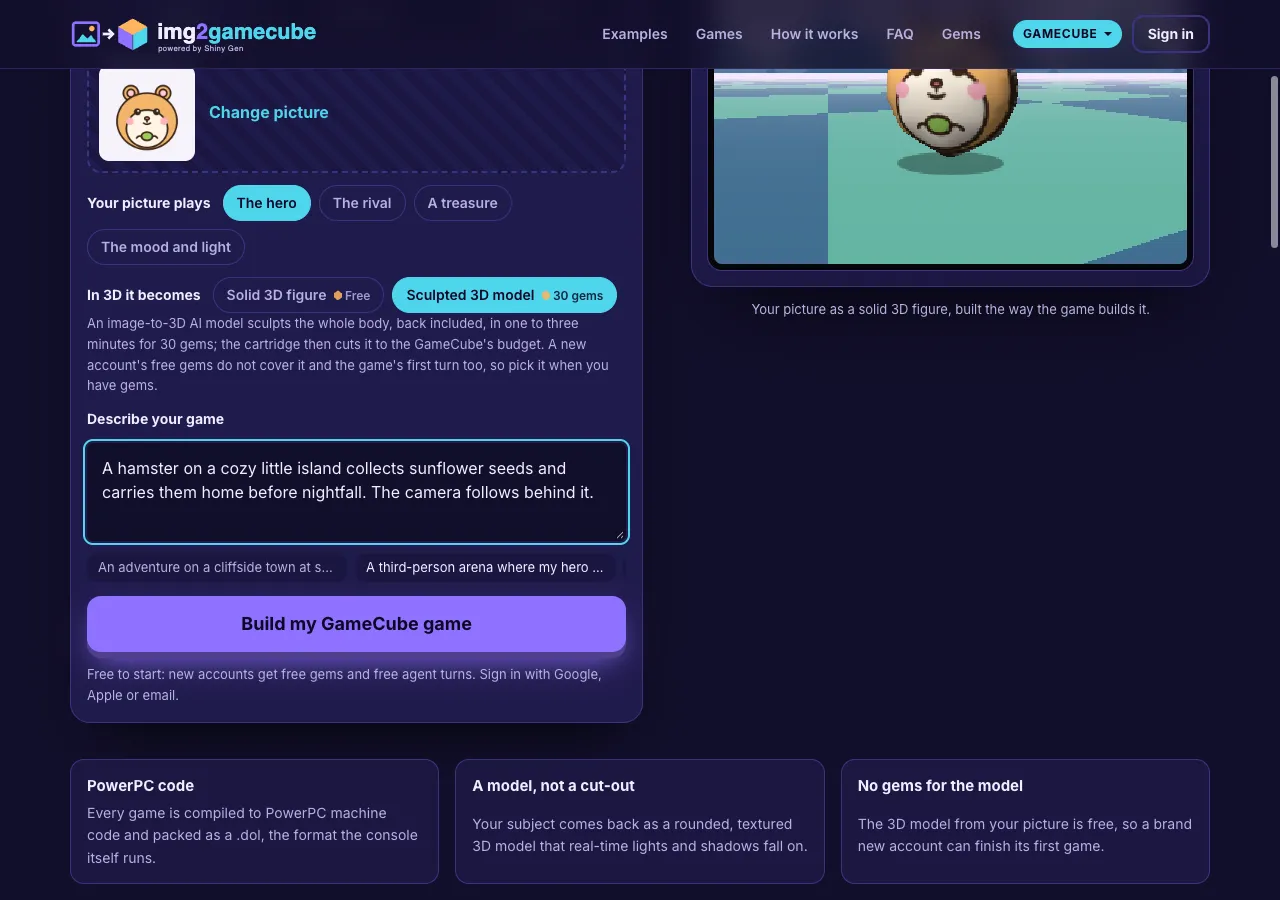
For a model with real sides and a back, choose Sculpted 3D model: an image-to-3D AI model builds a full body from your picture in one to three minutes for 30 gems, and the cartridge reduces it to 2,000 triangles.
How they differ in practice
Fidelity. img2threejs aims for a faithful rebuild of the object, judged pass by pass against the picture, with structure, materials and detail. img2gamecube's free figure keeps your picture exactly as it is, as the texture on a rounded body: it looks like your drawing because it is your drawing, but it is not sculpted. The back shows the picture seen through.
Time and effort. img2threejs runs a multi-pass reconstruction in your agent, which you install and drive, and its own token estimates are 80k to 180k tokens for an object. img2gamecube's figure is ready in about a second, and in our sessions a whole first game took about two to three minutes.
What you own at the end. img2threejs leaves you code in your own repository, under your control. img2gamecube leaves you a game in your Shiny Gen account, which you can play, share and remix, and export as a .dol after any one purchase, from $2.99.
What it runs on. img2threejs targets Three.js, so the model goes anywhere Three.js runs. img2gamecube targets our sGC engine, which is modeled on the GameCube: 640 x 480, eight hardware lights, two analog sticks, 24 MB of memory and a memory card.
Which one to use
- Use img2threejs if you are building a Three.js scene, a product viewer or your own web game, you already work in a coding agent, and you want a detailed, rigged model as reviewable code.
- Use img2gamecube if you want a game: your character in a lit 3D world, with goals, a camera and controls, that you can play and send to someone today, without installing anything or writing code.
FAQ
Is img2gamecube built on img2threejs?
No. They are separate projects. img2gamecube's free figure is made by the Shiny Gen app itself, and the game runs on Shiny Gen's own GameCube engine, not Three.js.
Can img2threejs make a game?
It makes models, and its gallery includes a mini game built around a code-only model. The game around the model is yours to write, in your own project and agent.
Do I need a coding agent for img2gamecube?
No. The agent is built into the site. You write what the game is in plain words, and it writes, compiles and tests the code. You can read the code in the studio if you want to.
Which gives the more detailed model?
img2threejs, by design: it rebuilds structure and materials and checks them against the picture. img2gamecube's free figure is a rounded shape carrying your picture, sized for a console. The 30-gem sculpted model on img2gamecube adds a full body with sides and a back.
Is either one free?
img2threejs is free, open-source software; you pay whatever your coding agent costs to run. img2gamecube is free to start: the figure costs no gems, a new account gets 30 free gems and free agent turns, and gem packs start at $2.99.
Further reading
Last updated: November 17, 2026